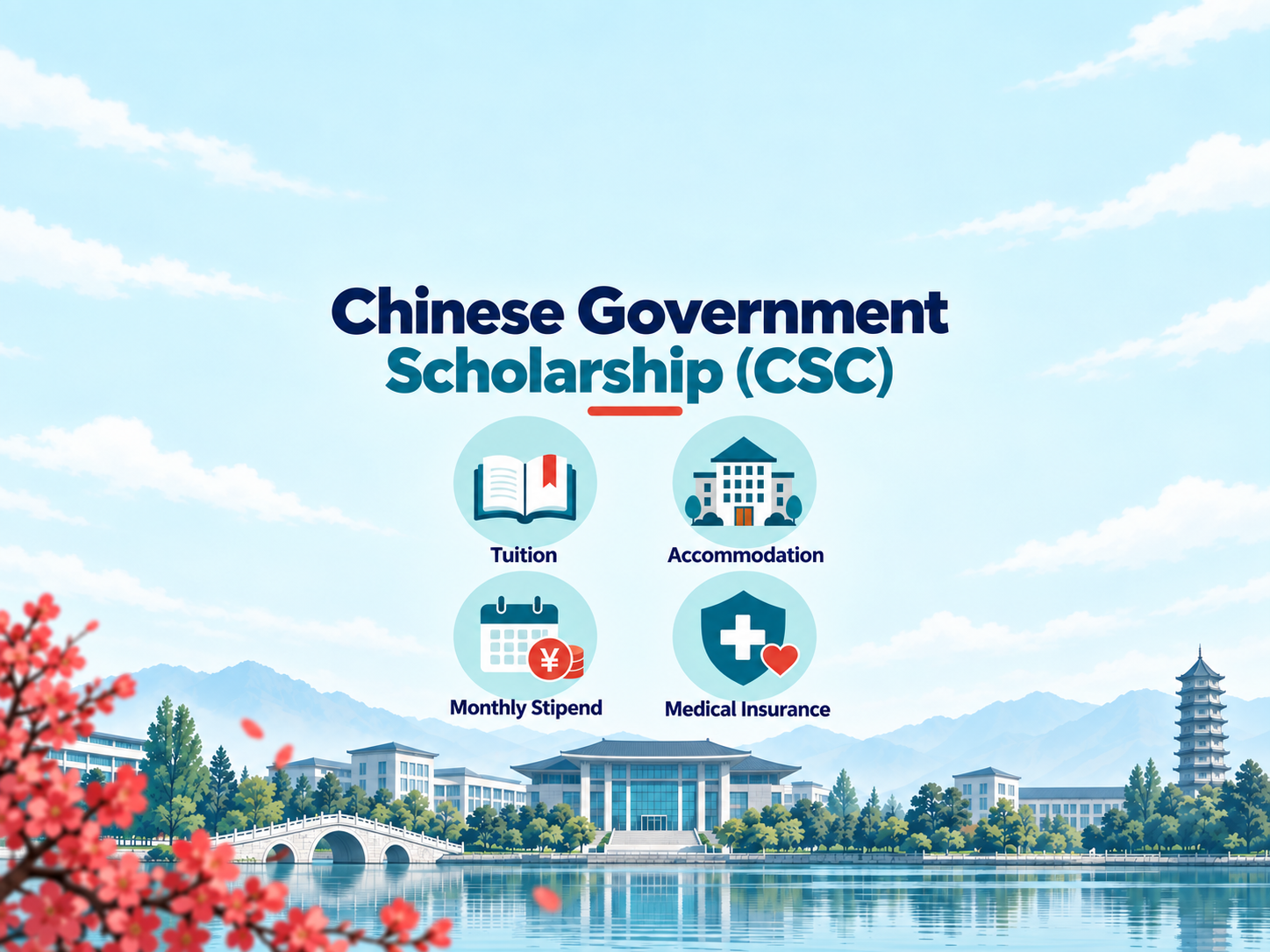

Starting in 2026, all international applicants for undergraduate programs under the Chinese Government Scholarship are required to submit scores from the China Scholastic Competency Assessment (CSCA). Administered and promoted by the China Scholarship Council (CSC), this examination system is regarded as a key reform initiative in the internationalization of China’s higher education in recent years.
For a long time, admission to undergraduate programs for international students in China has been based mainly on a comprehensive evaluation of language proficiency scores, senior high school academic performance and reference documents. However, disparities in grading systems and curriculum structures across countries have made it difficult for universities to make side-by-side comparisons of applicants’ academic competencies. Against this backdrop, the introduction of the CSCA serves as an institutional supplement. Its core objective is to establish a uniform, comparable benchmark for measuring academic ability and provide a more credible basis for scholarship selection and undergraduate admissions.
This policy adjustment is not an ad-hoc decision; it aligns closely with China’s strategic push to improve the quality of international student education in recent years. With the continuous advancement of the “Double First-Class” Initiative, Chinese universities have shifted from expanding the scale of international student recruitment to prioritizing quality. Education authorities have repeatedly stressed the need to maintain an open stance while raising admission thresholds and academic standards, so that international students can complete their studies smoothly and integrate into specialized training programs. The CSCA therefore functions as a “quality filter”. Its design draws on internationally accepted standardized testing models while incorporating China’s senior high school curriculum framework and foundational university teaching requirements, representing indigenous institutional innovation within a global context.
Examination Structure and Competency Focus: From Language Verification to Academic Assessment
Under the currently released framework, the CSCA combines compulsory and optional subjects. Mathematics is compulsory for all undergraduate applicants. It covers core senior high school topics including functions, algebra, geometry, trigonometry and sequences, placing emphasis on logical reasoning and problem-solving rather than rote memorization of formulas. Applicants to science, engineering and medicine programs must additionally take physics or chemistry depending on their intended major. Candidates applying for Chinese-taught programs are required to sit a specialized Chinese proficiency test. The exam is offered in both Chinese and English to reduce the interference of language barriers on demonstration of academic ability and better assess true subject mastery.
Unlike previous practices that relied heavily on HSK or English test results, the CSCA focuses more on evaluating applicants’ academic readiness. Education professionals note that while language proficiency is essential for completing degree studies, mathematical thinking and basic scientific literacy often determine whether students can cope with the rigor of undergraduate coursework. Science and engineering majors, in particular, demand strong quantitative analysis skills; without a solid foundation, students may face substantial academic pressure later on. The unified testing standard enables universities to gauge applicants’ learning potential more objectively and supplies quantitative reference for scholarship allocation, enhancing the transparency and fairness of selection.
It is worth noting that the CSCA does not replace the existing application document package entirely; instead, it forms a vital component of holistic review. Universities will still consider senior high school transcripts, recommendation letters, personal statements and language scores when making admission decisions. Nevertheless, applications without CSCA scores will not proceed to the Chinese Government Scholarship review process. This dual model combining mandatory requirements with comprehensive evaluation represents an institutional balance between standardization and diversity.
Policy Impacts and Debates: Greater Fairness or Added Burden?
The rollout of the CSCA has sparked extensive discussion within global education circles. Proponents argue that a unified academic assessment removes uncertainties stemming from divergent grading systems worldwide. In the past, senior high school curricula in some countries leaned toward liberal arts or adopted different scoring rubrics, making it hard for universities to accurately assess applicants’ grounding in science subjects. A standardized exam allows candidates from different regions to be measured on the same scale, rendering admission decisions more evidence-based. For international students aiming to attend top Chinese universities, clear examination requirements also create a well-defined preparation pathway.
On the other hand, concerns have been raised over exam costs and equity. For students from economically disadvantaged backgrounds, taking an international exam entails expenses for registration fees, study materials and potentially tutoring. Education observers are watching whether the CSCA, if extended to all international undergraduate applicants beyond scholarship candidates in the future, will raise the overall barrier to studying in China. Furthermore, given the exam’s close alignment with China’s senior high school curriculum, ensuring fair competition among applicants from varied educational backgrounds remains an area for further policy refinement.
Despite such debates, most university administrators hold the view that the long-term value of the CSCA lies in lifting overall training quality. Chinese universities have seen steady improvements in research performance in global rankings in recent years, yet undergraduate education quality and student cohort composition are equally important. Higher academic standards at the entry stage help improve classroom outcomes and foster a more competitive academic environment. From this perspective, the CSCA acts both as a selection tool and a quality assurance mechanism.
Future Trends and Preparedness Strategies: Opportunities amid Institutional Development
As planned, the first global administration of the CSCA took place in 2025. Starting in 2026, it will become a mandatory requirement for Chinese Government Scholarship undergraduate applicants, with its scope to be expanded gradually in subsequent years. Education authorities state that the exam syllabus and marking scheme will be adjusted continuously based on operational data and feedback from universities to boost its international relevance and scientific validity. Industry forecasts suggest some universities may increase the weighting of CSCA results in independent admissions and even use them to differentiate scholarship tiers.
For international students planning to pursue undergraduate degrees in China, early familiarity with the exam structure and schedule is critical. Experts advise applicants to schedule review plans months in advance, prioritizing mathematics and relevant science subjects, while checking the specific score requirements of target institutions. Alongside maintaining competitive language scores, candidates should treat the CSCA as an opportunity to showcase academic strengths rather than merely a qualifying hurdle. Educational agents and overseas high schools will also need to adjust their academic guidance to help students meet the academic standards of Chinese universities.
From a broader perspective, the launch of the CSCA reflects institutional confidence and a quality-first orientation in the internationalization of China’s higher education. Against intensifying global competition in tertiary education, countries are strengthening admissions systems through standardized testing and quality evaluation. This move responds to domestic demands for quality improvement and sends a clear international message: studying in China is shifting from opportunity-based admission to competency-based admission. As the policy unfolds, its far-reaching impacts on the makeup of the international student body, scholarship distribution and university teaching quality remain to be seen. What is certain, however, is that 2026 will mark a major turning point in China’s undergraduate admissions system for international students.