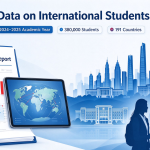
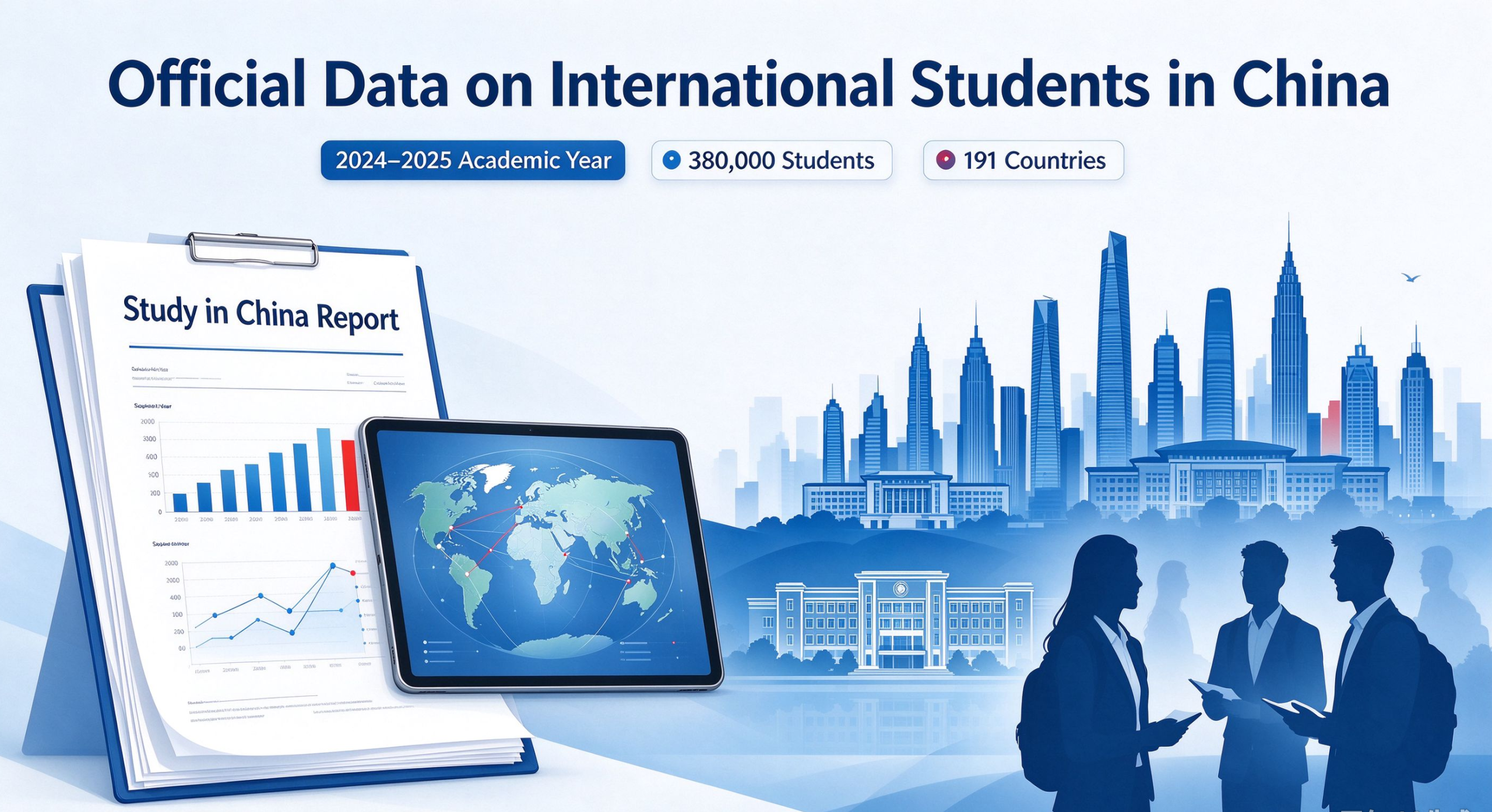
At the China Study Abroad Forum held in April 2026, the Department of International Cooperation and Exchanges of China’s Ministry of Education released detailed statistics on international students for the 2024–2025 academic year. The dataset was subsequently included in the Xinhua Think Tank report Studying in China: Better Serving the Building of a Community with a Shared Future for Mankind. According to the statistics, more than 380,000 international students from 191 countries and regions studied, trained or conducted research at over 1,100 universities, research institutes and educational institutions across 30 provincial-level administrative regions in China, representing a 15% increase year-on-year. This set of authoritative figures paints a comprehensive picture of international education in China.
Student Origins: Asia as the Main Source with Global Diversity
International students come from all over the world, with Asia as the primary source and growing enrolment from other continents. Students from Asia account for 61.1% of the total, Africa 16.2%, Europe 15.6%, and students from the Americas and Oceania together make up 7.1%. Southeast Asia, Central Asia and Africa are the fastest-growing source regions, and countries along the Belt and Road Initiative form a major group of incoming students.
Meanwhile, China continues to launch youth exchange programmes with partner countries. Under the initiative to invite 50,000 young Americans to China over five years, more than 42,000 young American participants had visited China by the end of 2025, representing all 50 U.S. states and Washington D.C. Such exchange schemes broaden recruitment channels and transform China’s international student programme from a regional exchange into a truly global educational partnership.
Academic Tracks and Programme Choices: Rising Share of Postgraduate Students; Engineering and Medicine Most Popular
China offers both degree and non-degree programmes for international students, with a clear upward trend in advanced-level enrolment. Degree-seeking students totalled 205,000, accounting for more than 60% of all international students. Postgraduate students make up 35% of the degree cohort, showing solid growth in high-level enrolment. A complete education pipeline covering bachelor’s, master’s and doctoral studies is well established. Many universities provide foundation programmes and Chinese language non-degree courses, offering a pathway for students whose Chinese proficiency is not yet sufficient to enter degree programmes directly.
In terms of subject preferences, programmes under the literature category (dominated by Chinese language training) have the largest headcount, around 148,000 students. Among degree-seeking students, engineering, medicine and management are the top three disciplines, together attracting more than 60% of degree students. Engineering alone accounts for 27.8% of all degree students. Apart from traditional strengths such as traditional Chinese medicine and Chinese language studies, cutting-edge fields including artificial intelligence, new energy and big data are gaining rapid popularity. Global interest in Chinese language learning continues to rise: 90 countries have integrated Chinese into their national education systems, and the total number of Chinese language learners worldwide exceeds 200 million, with HSK test centres operating across 168 countries.
Scholarship Support, Policies and Cost of Study
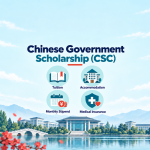
China maintains a multi-layered scholarship framework for international students. Recipients of the Chinese Government Scholarship account for approximately 8% of all international students and receive one of the most prestigious funding packages. In addition, provincial and municipal governments, individual universities and enterprises run their own scholarship schemes, offering tuition waivers or living stipends for students from different countries and disciplines.
At the national strategic level, the Outline for Building a Strong Education Country (2024–2035) sets out plans to strengthen the “Study in China” brand. China now conducts educational exchanges with 183 countries and regions and has signed agreements on mutual recognition of academic qualifications with 61 jurisdictions. Sino-foreign cooperative education institutions and programmes keep expanding, with more master’s and doctoral level partnerships being launched.
A distinctive feature of studying in China is the wide range of possible living costs. In megacities with a population over 10 million such as Beijing, Shanghai, Shenzhen and Guangzhou, monthly living expenses are roughly RMB 2,500–4,500. In other ordinary Chinese cities, students who eat mainly at campus canteens and live modestly can manage on around RMB 1,000 per month. These figures cover food, transport, mobile services and daily necessities and do not include accommodation. On-campus dormitory fees are generally RMB 1,000–4,000 per academic year. Total annual expenditure varies dramatically: a student on a Chinese-taught programme in an ordinary city living frugally can cover tuition, living costs and accommodation for RMB 20,000–30,000 per year. By contrast, English-taught programmes, medicine or business majors in megacities, or a more comfortable lifestyle, can easily cost RMB 100,000 and above annually. Students with full scholarships bear very little personal expense.
China is widely recognised for its safe and convenient living environment. Public security is stable, mobile payment and public transport systems are highly developed. Many cities have streamlined procedures for visa applications, residence permits and post-graduation work permits to support international students for internships, employment and entrepreneurship.
Career Pathways after Graduation: Further Study, Employment in China or Returning Home
After graduation, international students typically follow three main paths: pursuing further studies, working in China or returning to their home countries.
Research platforms in China, especially in science and engineering, enjoy growing international recognition. Many international students choose to continue their postgraduate studies in China or apply for programmes in other countries using Chinese qualifications. Those who seek employment in China benefit from the competitive edge of combining Chinese language competence with professional expertise. Talent policies and work permit rules for foreign graduates are continuously improved across cities. A large number of graduates return to their home countries and join overseas branches of Chinese enterprises or multinational firms, acting as bridges for trade and technical cooperation between China and the world. International vocational education is also expanding quickly. Hundreds of Chinese vocational colleges recruit overseas learners and deliver practical “language + skill” training, responding to talent demands in many developing economies.
Outlook: Shifting from Scale Expansion to Quality-Focused Development
The development of international education in China has moved past the stage of prioritising enrolment numbers and entered a quality-first phase. Admission criteria, academic supervision and graduation standards have become stricter. The proportion of postgraduate students and learners in practical disciplines such as engineering keeps rising. Non-degree Chinese language and cultural courses remain a flexible entry point for cultural exchange.
Against the backdrop of shifting global student mobility, China has become an increasingly attractive destination for young learners worldwide, thanks to its educational quality, cost advantages, safe social environment and industrial opportunities. “Study in China” offers not only academic training, but also a direct window for global youth to understand contemporary China and participate in bilateral cooperation, supporting cross-cultural exchange and people-to-people connectivity.