For students who are considering or preparing to study in China, the higher education system in this country is large, diverse and dynamic. It is home to world-class research universities, application-oriented institutions with close ties to industry, programs built on rigorous academic traditions, and a rapidly expanding portfolio of international partnerships. This article aims to present you with a complete overview, helping you understand the landscape of Chinese universities, available study pathways, application procedures, costs, campus life and post-graduation options. With this big picture in mind, you can start your journey to China with confidence.
1. Understanding the Tiers and Types of Chinese Universities
China has more than 3,000 higher education institutions, which vary greatly in positioning and resources. Grasping this classification system is the first step for school selection.
The Double First-Class Initiative is the core national framework for prioritising universities: it covers 147 universities in total, among which 42 are designated as World-Class Universities, and the rest as World-Class Discipline institutions. The older labels of Project 985 (39 universities) and Project 211 (112 universities) are still widely recognised internationally and referenced by employers and student applicants. At the very top sits the C9 League, comprising Peking University, Tsinghua University, Fudan University, Shanghai Jiao Tong University, Zhejiang University, Nanjing University, the University of Science and Technology of China, Harbin Institute of Technology and Xi’an Jiaotong University. These institutions represent the highest standard of academic research in China and enjoy strong global reputations.
Alongside comprehensive universities, there are many specialised institutions renowned for particular disciplines. These include leading science and engineering universities such as Huazhong University of Science and Technology, finance and economics universities like Central University of Finance and Economics and Shanghai University of Finance and Economics, language universities such as Beijing Foreign Studies University, normal universities for teacher training represented by Beijing Normal University, and medical schools including Peking Union Medical College. There are also dedicated academies for the arts, sport, agriculture and traditional Chinese medicine. When choosing, do not rely solely on overall rankings; check whether your target major is a flagship discipline at the university.
In terms of funding and governance, most high-quality universities are public institutions with relatively stable tuition fees. In recent years, private universities and Sino-foreign cooperative universities have also flourished. Examples include Xi’an Jiaotong-Liverpool University, the University of Nottingham Ningbo China and New York University Shanghai. These institutions usually adopt international curricula and English-medium instruction. They suit students who prefer an international learning environment, though tuition fees are noticeably higher.
2. Study Pathways: Degree Programmes and Non-Degree Courses
Chinese universities offer two broad categories of study options. Many international students only focus on degree programmes, while overlooking non-degree courses, an important entry route.
Degree programmes award formal academic qualifications, following the three-tier structure of Bachelor’s, Master’s and Doctoral degrees. A standard Bachelor’s programme lasts four years; medicine and architecture usually take five years. Academic Master’s programmes generally run for three years, and professional Master’s programmes for two to three years. Doctoral programmes normally take three to four years. China has expanded professional Master’s programmes rapidly in applied fields such as engineering, business and law. Meanwhile, the system is shifting from a historically lenient graduation model to a more rigorous one. Graduation requirements have become stricter, especially for postgraduate students, who are expected to produce academic outputs and complete qualifying theses.
Non-degree courses do not lead to formal degrees. They include language training, short-term cultural programmes and thematic workshops. The most popular options are Chinese language courses (sometimes subdivided into general Chinese, business Chinese and Chinese for education purposes) and courses on Chinese culture, such as calligraphy, traditional painting, tai chi, traditional Chinese medicine culture and Chinese history. Non-degree courses have flexible durations, ranging from several weeks of short workshops to one or multiple academic years of long-term study. They serve as a low-pressure way for new international students to experience China.
A valuable pathway deserves your attention: non-degree language students can progress into degree programmes, including Bachelor’s programmes. If you complete the required course hours and meet the assessment criteria (most commonly a satisfactory HSK score), you may apply directly for admission to the university’s degree programmes. This means if you do not yet meet the Chinese language entry requirement, you can first enrol as a language student to study and adapt in a Chinese-speaking environment, and then apply for a degree track later. Always confirm the specific transfer policies and eligibility rules with the International Student Office of your target university.
3. Medium of Instruction: Chinese-Taught or English-Taught Programmes
This is one of the core decisions you need to make when selecting programmes.
Chinese-taught programmes make up the majority of mainstream degrees. Applicants normally need a recognised HSK score: roughly HSK Level 4 for most Bachelor’s programmes, with higher requirements for postgraduate study. This route is ideal for students hoping to integrate deeply into Chinese society and seek career opportunities in China after graduation.
English-taught programmes have grown fast, especially in business, engineering, computer science and medicine. Applications for these tracks usually do not require Chinese proficiency certificates, but competition is intense and tuition fees are higher.
Even if you choose an English-taught programme, basic Chinese will greatly improve your daily life experience. Simple Chinese skills help with shopping, dining and social interaction. Your Chinese ability often determines whether you can truly integrate into life in China, rather than merely staying on campus.
4. Application: Channels, Procedures and Timelines
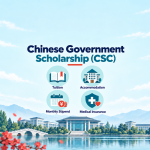
You may submit applications through three main channels. First, most universities host dedicated international student admission portals on their official websites for direct online applications. Second, the China Scholarship Council (CSC) administers the Chinese Government Scholarship, which is highly competitive and prestigious. It may cover tuition, accommodation, living stipends and even international travel fares. Third, provincial and municipal governments, as well as individual universities, offer their own scholarship schemes with varied coverage and benefits.
Typical application documents include a passport copy, authenticated and translated degree certificates, academic transcripts, language test results (HSK, IELTS or TOEFL), reference letters, a personal statement or study plan, and a medical examination report. Some universities also conduct interviews.
Most universities open applications for the September intake (autumn semester) from October of the preceding year to March of the admission year. Scholarship deadlines are often earlier. You are advised to start preparing language tests and supporting documents at least one year in advance. If you plan to enter via the language student pathway and transfer to a degree programme later, you need to plan according to the separate timelines for language courses and subsequent degree admissions.
5. Costs and Scholarships
Compared with study destinations in many developed economies, studying in China offers good value for money, though costs vary significantly by university and major. Below are the mainstream tuition ranges for reference.
- Chinese-taught Bachelor’s programmes: RMB 10,000–30,000 per year. Humanities and social science programmes tend to sit at the lower end, while medicine and fine arts are usually more expensive.
- English-taught programmes cost substantially more. Popular majors such as clinical medicine may charge RMB 50,000 or higher annually.
- Postgraduate tuition is generally higher than undergraduate tuition. Top universities set high fees for Master’s and Doctoral programmes, with business and finance programmes among the priciest.
Living costs vary greatly across China, depending mainly on the city you study in and your spending habits. In megacities with a population of over 10 million, such as Beijing, Shanghai, Shenzhen and Guangzhou, monthly living expenses are roughly RMB 2,500–4,500. In other ordinary Chinese cities, if you eat mostly at university canteens and live modestly, you can manage with around RMB 1,000 per month. These monthly amounts cover food, transport, mobile services, daily necessities and minor leisure costs, and do not include accommodation. On-campus dormitory fees are approximately RMB 1,000–4,000 per academic year, and off-campus rents differ widely.
Total annual costs cover a broad spectrum. If you take a Chinese-taught programme in an ordinary city and live frugally, the combined expense of tuition, living costs and accommodation can be as low as RMB 20,000–30,000 per year. If you study an English-taught programme, medicine or business in a megacity, or maintain a more comfortable lifestyle, the total annual cost can easily exceed RMB 100,000. Students awarded full scholarships have very little personal expense. All figures are for reference only. Always check the latest official fee information from your chosen university.
6. Campus Life and Cultural Adaptation
On-campus accommodation is common at Chinese universities. Most international students stay in dedicated international student dormitories, usually single or twin rooms equipped with private bathrooms, air conditioning and internet access. Facilities vary from university to university.
University canteens are known for affordable, accessible food. A standard meal costs about RMB 10–25. Many campuses provide halal options and diverse dishes to accommodate different dietary habits, though spicy local flavours may take time to get used to.
Campus clubs and student associations are abundant, covering sports, music, arts, academic societies and volunteer work. Events such as International Culture Festivals and welcome galas are excellent opportunities to meet Chinese peers and build social connections.
China enjoys generally safe urban environments. Mobile payment systems such as WeChat Pay and Alipay are widely used, making it convenient to order food, take rides and settle daily payments with a smartphone. Public transport networks are well developed in most cities.
Cultural differences can pose greater challenges than academic work. Classroom teaching in China tends to be structured and teacher-centred, with less spontaneous debate than you may find in Western classrooms. Nevertheless, professors welcome proactive communication. Social interactions are often more reserved at first. Simple Chinese greetings and polite phrases can help build rapport. Chinese culture values tact and harmony; criticism is often expressed indirectly. Major holidays including the Spring Festival (usually January or February) and National Day bring long breaks, which you should note when planning travel.
7. Post-Graduation Options and Pre-Departure Checklist
After graduation, international students have three main directions. First, you can pursue higher degree programs in China or overseas. China’s research platforms, especially in science and engineering fields, have gained rising global recognition. Second, you can seek employment in China. Professionals combining Chinese language skills and specialised expertise are highly competitive in the job market. You will need a valid work permit, and talent policies differ across cities. Third, you may return to your home country. Chinese degrees are recognised in many countries under international qualification recognition agreements, and study experience in China can strengthen your resume. Many cities introduce preferential policies for international talent and entrepreneurship.
Before departure, keep these key points in mind:
- Plan well ahead. Popular programs and scholarships have strict deadlines, so start preparations at least harlf a year early.
- Prioritize language learning. Your language proficiency shapes your academic and social experience, whether you join a Chinese or English-taught track.
- Consider the language student transfer pathway strategically. If your Chinese is not yet sufficient for direct degree entry, non-degree language courses can be a reliable stepping stone.
- Prepare financially and mentally. Set aside time to adjust culturally and cope with homesickness.
- Make full use of university resources. The International Student Office, senior international students and campus communities are your best guides.
- Stay open-minded. China is a vast country with huge regional diversity. When choosing a university, consider the city alongside the institution itself.
Chinese higher education is internationalising at an unprecedented pace, opening a window for global learners to discover a nation that is both ancient and modern. It is not only a place to receive high-quality education, but also an experience that reshapes how you see the world. We hope this full picture helps you take your first step with confidence. Campuses across China are ready to welcome you.