

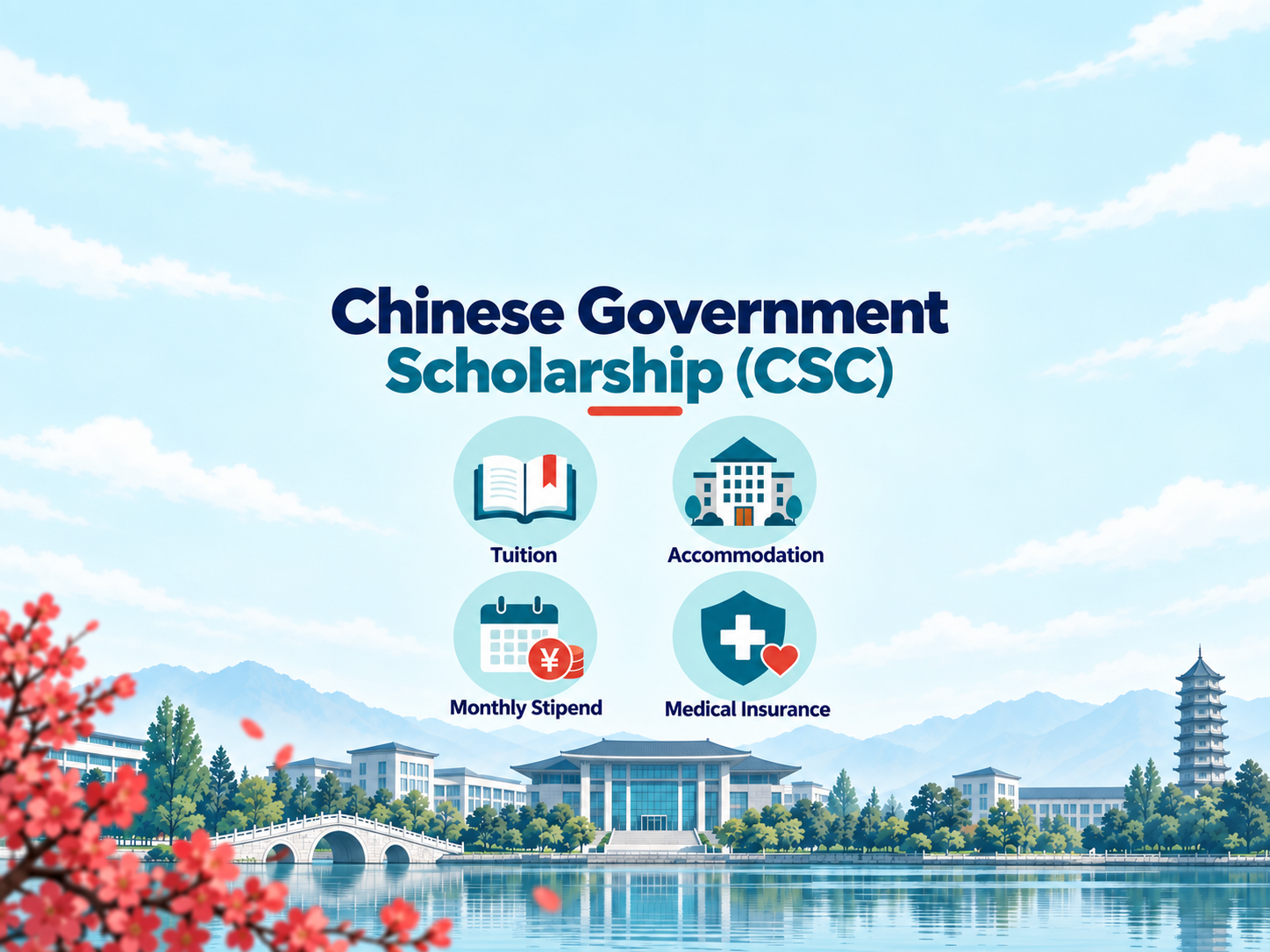
The Chinese Government Scholarship is one of the most important funding opportunities available to international students who wish to study in China. Established by China’s Ministry of Education, the scholarship supports qualified students and scholars from around the world. The China Scholarship Council, commonly known as CSC, administers applications and manages scholarship recipients on behalf of the Ministry of Education.
The scholarship covers a wide range of universities, degree levels, and academic disciplines. However, available programs, eligibility rules, application channels, and deadlines may differ by country, university, and scholarship category. Applicants should therefore consult the latest official announcement for their chosen route.
What Does the CSC Scholarship Cover?
Chinese Government Scholarships may be full or partial. A typical full scholarship includes:
- A tuition waiver;
- Free university accommodation or an accommodation subsidy;
- Comprehensive medical insurance; and
- A monthly living allowance.
Under current standards commonly stated in university guidelines, the monthly allowance is generally RMB 2,500 for undergraduate students, RMB 3,000 for master’s students and general scholars, and RMB 3,500 for doctoral students and senior scholars. The exact benefits depend on the scholarship program and host institution. For example, the 2026 Xiamen University guide lists tuition, accommodation, medical insurance, and monthly stipends as elements of its full Chinese Government Scholarship.Xiamen University: 2026 CSC Guide
International airfare and personal expenses are not automatically covered unless the relevant program specifically states otherwise.
Who Is Eligible?
Eligibility varies, but applicants must generally:
- Be citizens of a country other than the People’s Republic of China;
- Be in good physical and mental health;
- Meet the academic requirements of the chosen university and program;
- Satisfy the applicable age limit;
- Demonstrate the required Chinese or English proficiency; and
- Not hold another Chinese government scholarship at the same time.
Common age limits are under 25 for undergraduate applicants, under 35 for master’s applicants, and under 40 for doctoral applicants. General scholars are often required to be under 45, while senior scholars are normally under 50. These limits may vary for particular programs.
Applicants to Chinese-taught programs usually need a valid HSK certificate. The required level depends on the university and subject. Applicants to English-taught programs may need IELTS, TOEFL, or other evidence of English proficiency. Some universities waive an English test when an applicant’s previous education was conducted in English.
From the 2026 admission cycle, applicants for certain bachelor’s programs may also be required to take the China Scholastic Competency Assessment, or CSCA. Applicants should check the current scholarship and university instructions carefully rather than assuming that the same requirements apply everywhere.Beijing Language and Culture University: 2026 Scholarship Guide
Type A and Type B Applications
Applicants often encounter two main application categories.
Type A generally refers to scholarships administered through a dispatching authority, such as the Chinese embassy, a government ministry, or another authorized organization in the applicant’s home country. These opportunities may be offered under bilateral agreements. Applicants must obtain the correct agency number and follow the local authority’s procedures.
Type B usually refers to programs for which candidates apply through a participating Chinese university. Applicants normally submit information through the CSC online system and also complete the university’s own application. Each university has a unique agency number. Entering the wrong number or program category can direct the application to the wrong institution.
Type B opportunities are often concentrated at the postgraduate level, although availability varies. Applicants should never select a category simply because it appears in the online system; they should first read the current university scholarship guide.
Documents Commonly Required
Although requirements differ, applicants are commonly asked to provide:
- The online Chinese Government Scholarship application form;
- A valid passport information page;
- The highest diploma or proof of expected graduation;
- Official academic transcripts;
- Chinese or English language certificates;
- A study plan or research proposal;
- Two academic recommendation letters for postgraduate applications;
- A Foreigner Physical Examination Form;
- A recent certificate of no criminal record;
- A pre-admission letter or supervisor’s acceptance letter when required; and
- Examples of research, publications, awards, or other achievements where relevant.
Documents not issued in Chinese or English generally require notarized translations. Scans should be complete, clear, and authentic. Medical and criminal-record documents may have limited periods of validity, so applicants should not obtain them too early.
Doctoral applicants are frequently expected to contact potential supervisors and present a detailed research proposal. A generic proposal sent to many universities is unlikely to demonstrate strong academic fit.
How to Apply
A typical application process involves the following steps:
- Identify an appropriate scholarship program and application channel.
- Confirm that the chosen university, degree, and major are eligible.
- Check academic, age, language, and nationality requirements.
- Prepare the required documents and translations.
- Apply through the CSC Study in China system.
- Submit a separate application to the university or dispatching authority if required.
- Pay any university application fee that is not waived.
- Attend an interview or academic assessment if invited.
- Wait for university nomination and final CSC review.
The official CSC application portal is available through the Study in China system.
A university’s recommendation does not necessarily mean that the scholarship has been awarded. CSC or the relevant authority may still conduct a final review.
When Should You Apply?
Deadlines vary widely. Applications for September enrollment commonly open between the preceding autumn and early spring. Some university programs close in December, while embassy or bilateral routes may continue into March or April. For example, Zhejiang University’s 2026 Type B deadline was December 31, 2025, whereas application schedules through embassies may follow different national timetables.Zhejiang University: Chinese Government Scholarship
Students should ideally begin preparing six to twelve months before enrollment. Early preparation is especially important when language testing, document notarization, supervisor contact, or pre-admission is required.
How Are Candidates Selected?
The CSC Scholarship is competitive. Universities may assess academic performance, language proficiency, research potential, the quality of the study plan, recommendation letters, interview performance, and compatibility with the proposed program or supervisor.
A strong application is accurate, coherent, and tailored to the institution. Applicants should explain why the program fits their previous education and how studying in China supports their future academic or professional goals. False documents or misleading information may result in disqualification.
Final Advice
There is no single application method or deadline for every CSC Scholarship. Always verify information through the CSC system, the relevant Chinese embassy or dispatching authority, and the official website of the intended university.
Poros Academy can help applicants identify suitable programs, understand application requirements, organize documents, refine study plans, and manage the application process. However, final admission and scholarship decisions are made exclusively by universities, CSC, and the responsible authorities.


Leave a Reply