


China offers international students an increasingly diverse range of educational opportunities, from Chinese-language courses and undergraduate degrees to research-based master’s and doctoral programs. Universities provide programs in engineering, medicine, business, economics, artificial intelligence, international relations, communication, the humanities, and many other fields. A growing number are taught partly or entirely in English.
Applying successfully, however, requires more than selecting a famous university. Requirements differ by institution, degree level, language of instruction, and scholarship route. This guide explains the major steps and important changes affecting international applicants in 2026.
1. Choose the Right Degree and Program
Begin by identifying your intended level of study:
- Chinese-language or foundation program;
- Bachelor’s degree;
- Master’s degree;
- Doctoral degree; or
- Visiting or non-degree study.
Next, search the international admissions websites of suitable universities. Do not rely only on general rankings. Compare the curriculum, teaching language, academic strengths, tuition, location, accommodation, scholarship opportunities, and graduate prospects.
Always confirm that the program is open to international students. A university may offer a subject to Chinese students but not include it in its international admissions catalogue. English-taught options also vary considerably. Tsinghua University, for example, states that its 2026 international graduate offerings included more than 30 programs taught fully in English, while other programs were taught in Chinese or bilingually.Tsinghua University 2026 Graduate Admissions
A balanced application list normally includes ambitious choices, universities that closely match your qualifications, and safer alternatives.
2. Check Your Eligibility Carefully
International applicants are generally required to be non-Chinese citizens holding valid ordinary passports, to be in good health, and to meet the educational requirements of the proposed degree.
Bachelor’s applicants normally need a recognized high school diploma or must be completing high school before registration. Master’s applicants generally need a bachelor’s degree, while doctoral applicants usually need a master’s degree. A limited number of doctoral programs accept outstanding bachelor’s-degree holders directly.
Applicants with Chinese parents, former Chinese nationality, or previous household registration in China may need to provide additional nationality and residence documents. These rules are detailed and should be reviewed before paying an application fee. Universities and Chinese authorities may determine that an applicant does not qualify for international-student status even when that person holds a foreign passport.
Age limits are more common in scholarship applications than in self-funded admission. For example, Chinese Government Scholarship applicants are often expected to be under 25 for bachelor’s study, under 35 for master’s study, and under 40 for doctoral study. Individual programs may impose different limits.
3. Confirm the Language Requirement
For Chinese-taught programs, universities normally require an HSK certificate. The required level varies by institution and discipline. Some undergraduate programs accept HSK 4 at the application stage but require HSK 5 before enrollment. Highly selective programs may demand HSK 6.
For English-taught programs, applicants whose previous education was not conducted in English may need IELTS, TOEFL, or another recognized qualification. Minimum scores vary. Donghua University’s 2026 undergraduate guide, for example, required IELTS 5.5 or TOEFL iBT 72 for its English-taught programs, while other universities or competitive programs may set higher thresholds.Donghua University 2026 Undergraduate Guide
Some universities accept an official letter confirming that the applicant’s previous education was taught entirely in English or Chinese. Never assume that such a letter will automatically replace a test score; check the specific program rules.
4. Understand the CSCA Requirement
One of the most significant developments in 2026 undergraduate admissions is the use of the China Scholastic Competency Assessment, or CSCA. A growing number of universities and Chinese Government Scholarship programs require international bachelor’s applicants to submit a valid CSCA score.
Required subjects depend on the intended major. Mathematics may be required for economics, engineering, science, or technology programs, while medicine and other science-intensive programs may require additional subjects such as physics or chemistry.
Not every applicant or university follows exactly the same arrangement. Check the current university guide and the official CSCA information before registering. Allow sufficient time to take the required examination and receive the result before the application deadline.
5. Prepare Your Application Documents
A typical application may require:
- A valid passport information page;
- A recent identification photograph;
- High school or university graduation certificates;
- Complete academic transcripts;
- Proof of expected graduation if you are still studying;
- HSK, IELTS, TOEFL, or other language results;
- A personal statement or study plan;
- A résumé or curriculum vitae;
- Recommendation letters;
- A research proposal for some postgraduate programs;
- A Foreigner Physical Examination Form;
- A certificate of no criminal record;
- Proof of financial support;
- A guardian document for applicants under 18; and
- Additional portfolios, publications, or professional certificates where relevant.
Documents issued in languages other than Chinese or English usually need certified or notarized translations. Some universities require color scans made with a scanner rather than photographs taken with a mobile phone. Peking University’s 2026 postgraduate instructions, for example, required original or notarized documents in Chinese or English and stated that mobile-phone photographs were not acceptable.Peking University 2026 Graduate Admissions
Names, dates, passport numbers, and academic records must be consistent across every document. Never alter transcripts or certificates. Universities may cancel an application, admission offer, or enrollment if materials are false or misleading.
6. Write a Strong Personal Statement
A strong statement should answer four questions:
- What have you studied and achieved?
- Why have you chosen this subject?
- Why is this particular university appropriate?
- How will the program support your future plans?
Avoid sending the same generic statement to every institution. Refer to relevant courses, research areas, laboratories, or faculty expertise. Graduate applicants should explain their academic preparation and proposed research clearly. Doctoral candidates may also need to contact a potential supervisor and secure an acceptance or recommendation letter.
Recommendation letters should come from teachers or scholars who genuinely know your academic abilities. Give recommenders adequate time and provide them with your résumé, study plan, and submission instructions.
7. Follow the Correct Application Procedure
Most universities use their own online admissions systems. Applicants create an account, select a program, enter personal and academic information, upload supporting documents, and pay an application fee.
Scholarship applications may involve an additional platform. For a Chinese Government Scholarship, for example, students may need to complete both the CSC Study in China application and the university’s own application. Embassy-administered and university-administered scholarship routes use different program categories and agency numbers.
Before submitting, check that:
- You selected the correct degree, major, and teaching language;
- Every required document has been uploaded;
- Translations and notarizations meet the rules;
- The application fee has been paid;
- Recommendation letters have been received; and
- The system status shows “Submitted.”
After submission, monitor both the portal and your email. A university may return the application for correction or invite you to an examination or interview. Failure to respond by the stated deadline can invalidate the application.
8. Plan Around the Application Calendar
There is no universal deadline for Chinese universities. For September 2026 entry, some competitive postgraduate applications opened in September or October 2025 and closed by December 2025. Other undergraduate and self-funded applications remained open until spring or early summer 2026.
Scholarship deadlines are often earlier than self-funded deadlines. Applicants should ideally begin six to twelve months before enrollment:
- September–November: Research universities and take language tests;
- November–January: Prepare statements, translations, and recommendations;
- December–April: Submit university and scholarship applications;
- March–June: Attend interviews and monitor decisions;
- June–August: Receive documents, apply for a visa, and arrange accommodation;
- August–September: Travel, register, and complete enrollment.
Because it is now September 2026, most degree applications for 2026 autumn entry have closed. Students beginning the process now should generally prepare for 2027, although some language, short-term, or spring-entry programs may still be available.
9. Explore Scholarships but Prepare a Budget
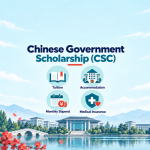
Funding may come from the Chinese Government Scholarship, provincial or municipal governments, individual universities, or other organizations. Awards may cover all or part of tuition and may also include accommodation, insurance, or a living allowance.
Scholarships are competitive and should never be treated as guaranteed. Prepare a realistic budget covering application fees, document certification, travel, housing deposits, meals, transportation, residence formalities, and personal expenses. Confirm whether a scholarship covers the entire program and what academic performance must be maintained.
10. Complete Visa and Enrollment Formalities
After admission, the university normally issues an admission notice and the documentation needed for a student visa. Under Chinese regulations, the X1 visa is intended for long-term study, while the X2 visa is used for short-term study.National Immigration Administration
Students entering with an X1 visa must complete the required residence-permit procedures after arrival. Follow the university’s instructions concerning medical verification, registration, tuition payment, insurance, and accommodation. Bring original academic and identity documents because the university may verify them during enrollment.
Final Checklist
Before applying, make sure you have:
- Selected an eligible program;
- Confirmed nationality, academic, age, and language requirements;
- Checked whether the CSCA is required;
- Prepared authentic documents and certified translations;
- Written a university-specific personal statement;
- Confirmed scholarship and university deadlines;
- Submitted through every required system; and
- Regularly checked your email and application status.
Applying to a Chinese university is manageable when each requirement is handled carefully and early. Poros Academy can assist with program selection, document preparation, application review, scholarship planning, and pre-departure guidance. Admission, scholarship, and visa decisions remain the responsibility of the relevant universities and government authorities.
配图已同时生成,为4:3比例的博客特色图片:画面表现一名国际学生走向中国大学校园,建筑经过适度虚化且无校名或标识,既能传达“中国大学申请”的主题,也不会被误认为某所具体高校。


Leave a Reply